
Revenue Operations Consultant: Role, Work and When to Hire
Learn what a revenue operations consultant does, from CRM cleanup and attribution to forecasting and process alignment, and when fractional support fits.
Your dashboard looks full. Your forecast still misses at the last minute. Marketing and sales open the same CRM and walk away with different pipeline totals, and nobody can say which number finance should trust.
That's usually not a selling problem. It's a coordination problem across definitions, records, handoffs and reporting. A revenue operations consultant is hired to repair that connective layer, not to carry a quota or run a single function.
Table of Contents
What a Revenue Operations Consultant Owns
Say it's the final week of the quarter. Sales leadership expects a strong close, then several supposedly committed deals slip, shrink or turn out to have no confirmed budget owner. The forecast miss looks sudden, but the warning signs were sitting in stale close dates, vague stage definitions and incomplete opportunity records all quarter.
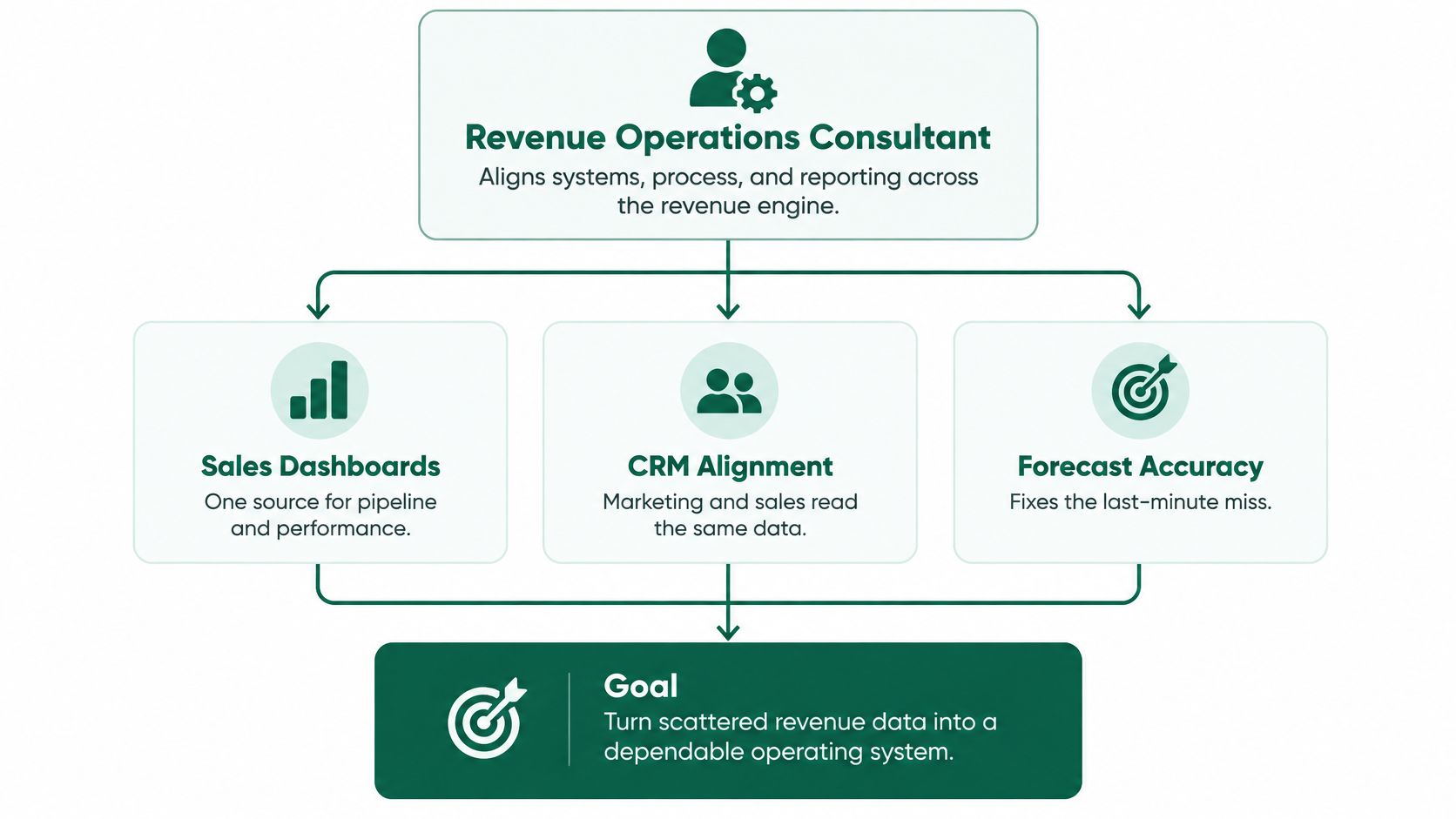
A revenue operations consultant designs and repairs the systems, data and processes that connect marketing, sales and customer success. Think of a conductor who plays no instrument but makes sure every section reads the same score and enters on the same beat. The work is cross-functional by design.
The Scope by Function
In sales, the consultant defines stage definitions, lead and account routing, territory and quota data, and the fields that feed the forecast. The symptom is familiar. Reps and managers argue about what's real in the pipeline while the number moves late.
In marketing, the work covers lead terms, source tracking and the link from campaign to opportunity. The symptom is a healthy lead count with few leads reaching revenue. In customer success, it covers the onboarding handover, renewal dates and account health data, where weak records mean expansion and churn signals arrive too late to act on.
For executives, the consultant sets one metric dictionary, shared pipeline views and a reporting cadence. That ends the meeting where leadership sees three revenue totals from three teams. Teams comparing outside support sometimes start by reviewing RevOps solutions for pipeline growth to clarify whether they need operational capacity, leadership, or both.
This is now a standard senior function. In 2025, 73% of surveyed U.S. companies had a C-suite role dedicated directly to revenue operations, according to Wakefield Research's survey of 400 RevOps and executive decision-makers.
What It Is Not
Sales operations is narrower and more execution-focused, usually serving the sales team only. A CRM administrator is tool-focused, managing fields, permissions and workflows. A revenue operations consultant may direct both kinds of work, but owns the design that connects them.
Ask three questions to test whether your problem fits. Do two teams use different definitions for the same term? Does a handover lose data someone downstream needs? Can leadership reconcile the pipeline to finance without a manual spreadsheet? If you answered yes, no and no, your problem is cross-functional.
Test Whether Your Data Is Ready for a Consultant
Most buyers start by asking which consultant to hire. I would start with a different question. Are you ready for optimization, or are you still in data repair?
A strategy problem means you're measuring the right things and the plan itself is wrong. A data, process or ownership problem means the inputs are unreliable, so you can't test any plan. Confusing the two is expensive, because you'll pay for analysis built on records nobody trusts.
The evidence points to repair more often than buyers expect. 40% of surveyed enterprise leaders experience data-quality problems that prevent accurate lead routing or assignment, and 44% identify data quality as a barrier to RevOps maturity, according to LeanData's B2B State of Martech and Revenue Operations report. A 2026 survey of 201 senior enterprise leaders also found that 82% consider foundational capabilities prerequisites for scaling AI, as reported in Momentum Nexus's revenue operations consulting buyer guide.
Revenue Readiness Signals
| Signal | How to check it | Red flag |
|---|---|---|
| Duplicate records | Sample accounts and contacts for duplicates | Duplicates rising, and reps stop trusting the CRM |
| Missing lifecycle fields | Completeness report by lifecycle stage | Required fields blank on closed deals |
| Lead response latency | Timestamp gap from lead creation to first touch | Response times vary widely by rep or source |
| Routing exceptions | Count of leads needing manual reassignment | Exceptions stay above the agreed baseline |
| Forecast variance | Forecast against closed results by period | Misses repeat without a documented explanation |
| Pipeline with reliable source | Share of opportunities with a populated source field | A large share of pipeline is unattributed |
Read the pattern, not just the individual row. One flagged signal is a warning you can fix inside normal operations. Several together mean the foundation won't support automation, attribution modeling or AI enrichment.
If routing rules can't trust territory, owner and account fields, automation only sends bad assignments faster.
I'd pause new automation or AI projects until routing and definitions are trustworthy. For an early-stage company, a cleanup-first engagement usually returns more value than a broad transformation, because every later decision depends on whether the underlying record is right.
The Work Streams a Consultant Usually Runs
Most engagements draw from five work streams. They usually start in the order shown below, because each one depends on the quality of the work before it.
Typical Consultant Work Streams
| Work stream | Typical deliverable | Symptom it addresses | Measure of success |
|---|---|---|---|
| CRM cleanup | Duplicate merge, required-field map, validation rules | Blank owners, duplicate accounts, unusable pipeline reports | Field completeness on required fields |
| Attribution | Source-of-record field, agreed attribution rule | Channel results that cannot be compared | Share of pipeline with a reliable source |
| Reporting and dashboards | Metric dictionary, shared dashboard, review cadence | Conflicting revenue totals between teams | One agreed total reconciled to finance |
| Process alignment | Handoff rules, decision-rights map, service levels | Leads routed wrongly, slow sales-to-success handovers | Lead response time and routing exceptions |
| Forecast governance | Forecast categories, stage-exit criteria, inspection cadence | Last-minute forecast misses | Forecast variance and bias over several periods |
These streams aren't independent projects. A poorly maintained lead-source field breaks attribution. Broken attribution distorts which pipeline leadership believes, and that distorted view feeds the forecast.
How the Streams Connect
Say a company has three definitions of a qualified lead. Marketing counts a form fill with a business email, sales development counts a completed call, and account executives count only leads with budget confirmed. A meaningful share of inbound leads reaches the wrong owner because territory rules run before anyone checks existing account ownership.
Marketing then reports pipeline using its definition while sales reports a smaller number using its own. Both teams can defend their spreadsheet. Neither number helps leadership decide where to spend next.
The sequencing logic matters. Fix definitions first, then records, then reporting. If you start with dashboards, you'll display bad data faster and give it a false sense of authority. That discipline also shapes the economics, which is why GTM payback optimization for RevOps teams is worth considering before you expand scope.
Not every company needs all five streams. A team with a handful of reps may need only CRM cleanup and reporting to get a forecast it can use. Answer one question from your own business before scoping anything. Which of these streams already causes friction this quarter?
CRM Cleanup Before Any Optimization
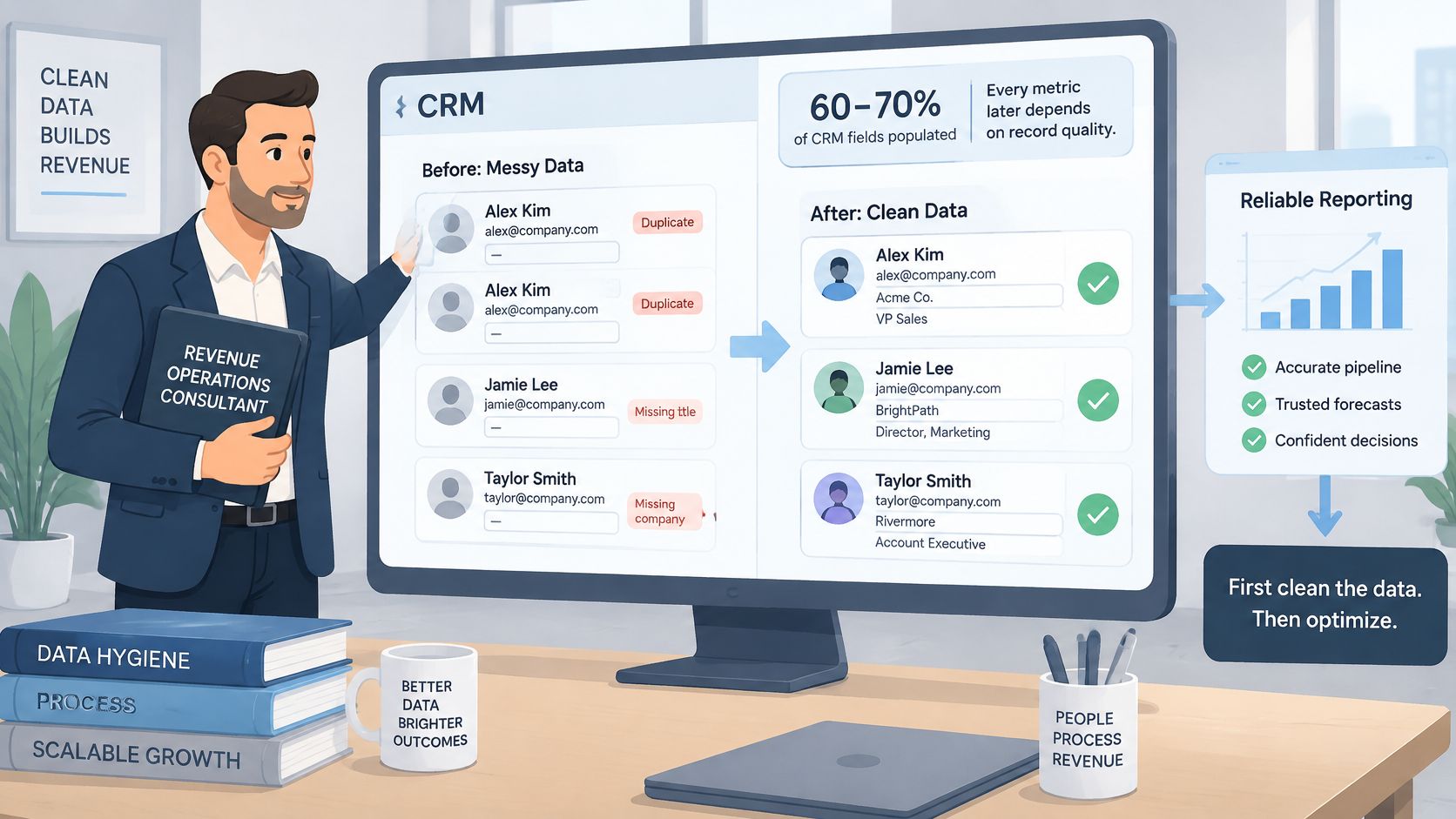
Every later number depends on the record underneath it. That's why cleanup comes first, even when it's the least glamorous part of the engagement.
The starting point is usually worse than leadership assumes. Only about 60–70% of CRM fields are consistently populated across B2B organizations, according to benchmark material cited by Clari's sales forecasting accuracy guide. A pipeline analysis built on raw records inherits those gaps.
Six Steps That Make Cleanup Stick
- Audit the damage. Count duplicate accounts and contacts, blank owners, and field completeness by stage. You need a baseline by field and owner, not a general sense that the CRM is messy.
- Classify every field. Mark fields as required for routing and stage progression, controlled picklists for segmentation and attribution, or optional context. This stops teams treating a forecast-critical field like a nice-to-have note.
- Write stage-exit criteria. Name the evidence needed to move a deal, such as a confirmed budget owner or an agreed mutual action plan. Opinion-based stage movement is how weak deals enter the forecast.
- Add validation at transitions. Block stage progress when amount, close date or owner is missing. It's better to annoy a rep at entry than surprise finance at quarter-end.
- Reconcile to finance. Match closed-won records and amounts against billing data to catch timing and value discrepancies. Teams that want to sustain this can later automate CRM data hygiene so duplicate checks and field monitoring don't depend on someone remembering a monthly spreadsheet.
- Review stale records on a cadence. Give a named owner a recurring review of stale close dates and aged stages. Cleanup without an owner decays within a quarter.
Practical rule: Connect every metric to an action. Stale close dates trigger inspection, missing amounts block forecast inclusion, and unexplained stage aging prompts a deal review.
Say a team's closed-won amounts in Salesforce or HubSpot differ from invoices because reps entered discounts inconsistently, some net and some gross. Finance is right, sales reporting is wrong, and neither team can see why until someone reconciles deal by deal. One agreed rule for where the discount lives fixes the argument.
Start by measuring completeness on the first three fields that drive your business. I'd pick owner, amount and close date, or source if routing is your biggest leak.
Attribution and Forecast Reporting Leaders Trust
A forecast isn't a sales management ritual. It's a data governance and process design problem, and treating it that way changes what the consultant does first.
In a survey of nearly 400 B2B enterprise organizations, 68% of companies missed their sales forecast by more than 10%, with lack of sales-representative accountability at 57%, poor CRM data quality at 44% and manual forecasting processes at 43% as leading causes, according to InsightSquared's 2021 State of Sales Forecasting release. Those causes point to fixes within a consultant's reach. Mandatory fields, clear ownership of close dates, evidence-based stage criteria and automated data collection all reduce the guesswork.
Forecast and Attribution Metrics a Consultant Tracks
| Metric | What it reveals | Common pitfall |
|---|---|---|
| Mean absolute percentage error (MAPE) | Average size of forecast error per period, regardless of direction | Hides whether misses lean high or low |
| Forecast bias | Whether forecasts consistently run high or low | Errors in opposite directions can cancel out across periods |
| Forecast accuracy within tolerance | Share of periods that land inside an agreed tolerance band | The tolerance must be set and agreed before measuring |
| Attribution coverage | Share of pipeline with a reliable source value | Low coverage makes channel return comparisons unreliable |
| Single attainment percentage | Progress against quota at one point in time | Says little about forecast quality and should not be the only metric |
Reading the Miss Properly
Baseline forecast error with MAPE, track forecast bias to see whether the team consistently over-calls or under-calls, then segment misses by rep, region, stage and deal age. That segmentation tells you whether the problem is coverage, timing, amount or classification. Each cause needs a different fix.
Attribution needs the same plain discipline. First-touch, last-touch and multi-touch models each answer a different question, so arguing about which one is true wastes time. The consultant helps you pick one rule finance accepts, define a source-of-record field, and require every team to populate it the same way. A deeper view of metrics from a RevOps perspective can help leaders separate useful signals from dashboard noise.
Say sales, finance and operations meet monthly to inspect the forecast before it reaches executives. They agree definitions first, review aged deals, then examine variance by segment. The number that reaches leadership has already survived the argument.
Process Alignment Across Sales, Marketing and Success
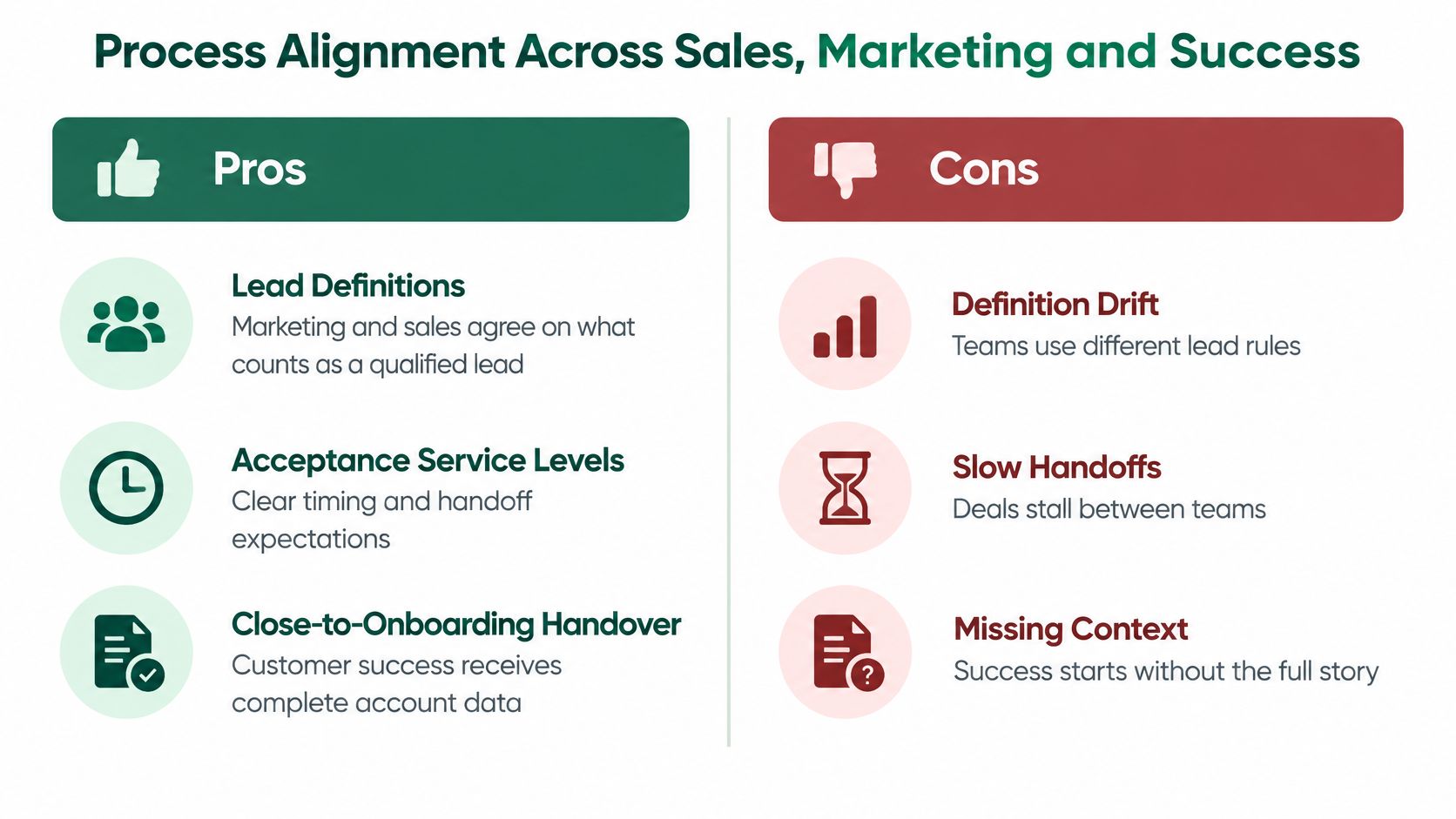
Revenue usually leaks at handoffs, not inside teams. Three handoffs cause most of the damage.
Marketing to sales breaks on lead definitions and acceptance timing. Sales to customer success breaks when the close-to-onboarding handover doesn't carry contract terms, stakeholders and promised outcomes. Renewal and expansion break when nobody can say who owns the next commercial conversation.
Centralized or Federated Ownership
A centralized model gives one team authority over definitions, tools and data. You get consistent definitions and one reporting view. The cost is speed, because local teams wait for a central queue to approve changes that feel urgent to them.
A federated model keeps operators close to their business units while the consultant sets shared standards. Local teams move faster and fit processes to their segment. The risk is drift, where each unit redefines a stage or source value until consolidated reporting stops meaning anything.
- Centralized fits when: Conflicting definitions already cause leadership arguments and finance can't reconcile team reports.
- Federated fits when: Business units sell different motions and shared standards can still cover core fields and stages.
- Either model fails when: Nobody owns change approval, so any admin can edit a picklist that reporting depends on.
The consultant's deliverables make the model real. Expect a decision-rights map naming who approves a change to stage definitions, a lead-response service level both teams sign, and a short written record of each shared definition. Without those artifacts, alignment is just a workshop outcome.
Say leads route by territory even when the account already belongs to another rep. Two reps call the same company, the account owner finds out late, and the prospect gets a messy first impression. Adding an account-ownership check before assignment fixes the routing and the internal dispute.
Choose based on one honest question. Do conflicting definitions cause you more damage than slow local changes would?
Choose Fractional Support or a Full-Time Hire
Don't choose by title. Choose by scope, stage and budget, in that order.
Scope asks whether you have one defined project or ongoing work across several teams. Stage asks whether an internal owner can take over after handover. Budget comes last because the cheapest option that leaves no owner behind isn't cheap.
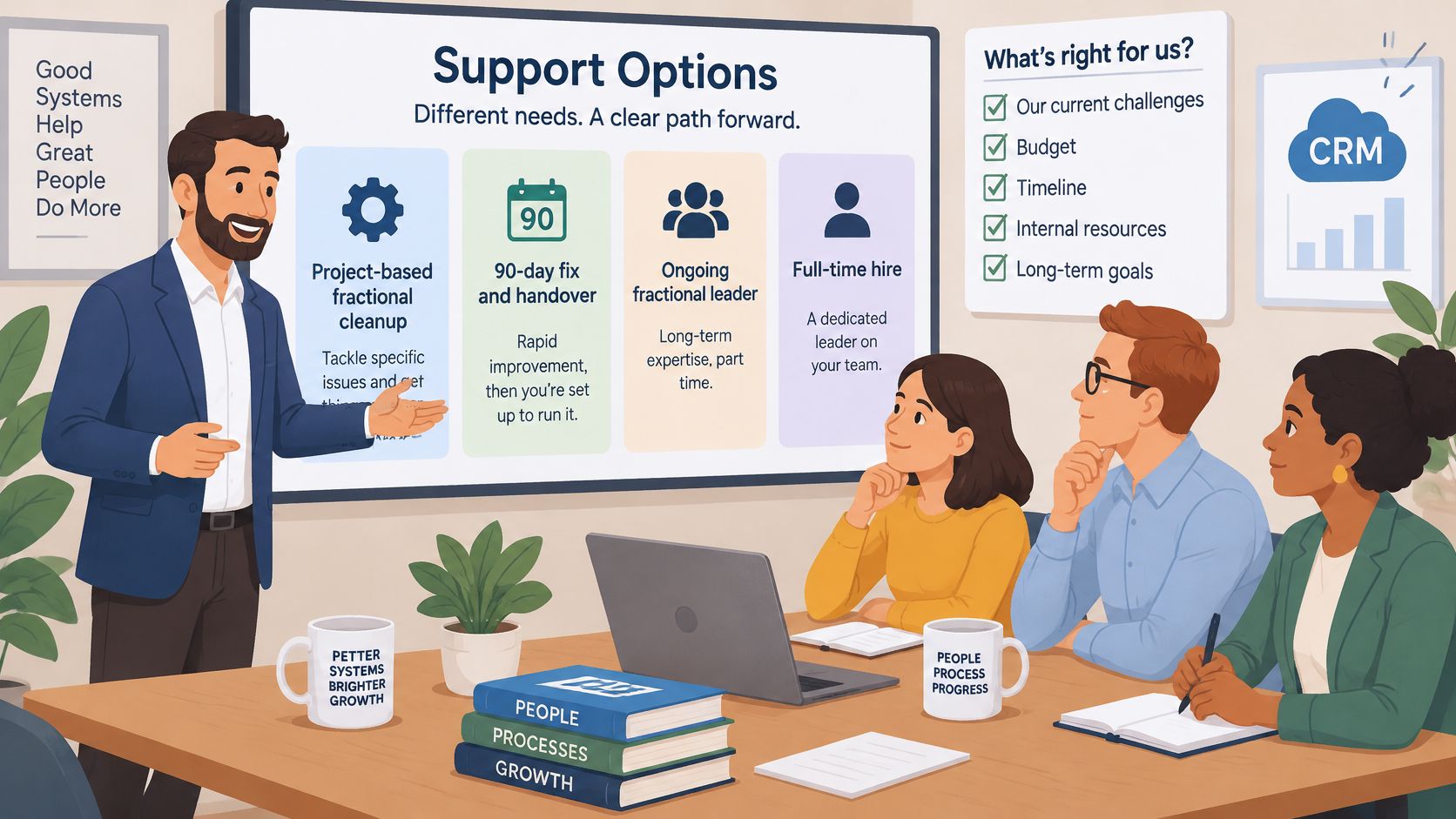
The image below is a useful prompt for that conversation with your leadership team, because the right model depends on the workload you can describe, not the one you hope appears.
Budgets are polarized. In 2025, 50.6% of revenue operations teams reportedly received no budget, while 33.7% received at least $50,000, according to Revenue Operations Alliance's salary and landscape report. That spread is why a bounded engagement often fits better than an immediate full-time commitment.
Fractional, Full-Time or Audit
| Option | Best fit | Main trade-off |
|---|---|---|
| Project-based fractional cleanup | A defined 90-day fix with a clear handover | Ownership must transfer to an internal team at close |
| Ongoing fractional leader | Several teams, no internal revenue operations owner yet | Recurring cost that needs a clear scope and exit point |
| Full-time revenue operations hire | Stable, multi-team operations with steady workload | Fixed salary and a longer hiring cycle |
| Diagnostic audit only | Diagnosis needed before deciding on any change | Recommendations need internal capacity to act on them |
Build the exit plan before you sign. Agree a 30-, 60- and 90-day scorecard against baseline metrics, require documentation, transfer ownership explicitly, and set an off-ramp if the baseline doesn't improve. If you're weighing the narrower alternative, this comparison of fractional revenue ops versus sales ops scope clarifies where each role stops.
The short video below is worth watching before you finalize scope, then compare its framing against your own readiness results.
A company with a handful of reps and a messy CRM usually needs the 90-day cleanup. A company with several teams and constant process change may need an ongoing fractional leader first. We keep the first step light if you use our matching process. You request an intro, we collect a short intake, then we make the warm connection, and we offer a free consultation with no sales pressure. Run your readiness check first, then pick the option that matches the result.
If your readiness check points to repair before optimization, Revenue Nomad can match you with a fractional revenue operations operator whose experience fits your stage and weakest foundation, whether that's CRM cleanup, attribution or forecast governance. Our process runs through matching, discovery and sales execution, so you start with a defined problem and a clear handover. Visit us to request an intro and scope a bounded first engagement.
Published via Outrank tool