
Sales Enablement Director: Duties, Skills and Results
A sales enablement director builds training, coaching and sales tools that lift quota attainment. See the duties, skills and metrics that matter.
Your best new hire can sell. Three months in, she's still shadowing calls, improvising discovery, and building her own decks because nobody owns the playbook. That's not a talent problem. It's a missing reinforcement loop, the system that turns training into behavior managers inspect every week. A sales enablement director owns that loop, and whether quota moves depends on how well they run it.
Table of Contents
- What a Sales Enablement Director Actually Does
- Seven Responsibility Areas at a Glance
- Building Onboarding and Coaching That Changes Behavior
- Measuring Enablement With Leading and Lagging Metrics
- Why Enablement and Sales Leaders Often Misalign
- Skills and Traits That Separate Strong Directors
- Decide Between a Full-Time Director and a Fractional Leader
What a Sales Enablement Director Actually Does
Say a strong seller joins your team. She spends weeks shadowing whoever's available, pieces together messaging from old decks, and learns your sales process by watching deals stall. Win rate stays flat, ramp drifts, and every manager coaches to a different standard.
A sales enablement director is the leader who makes sellers productive and consistent by running onboarding, training, coaching, sales content, performance measurement, and the handoffs between sales, marketing, and operations.
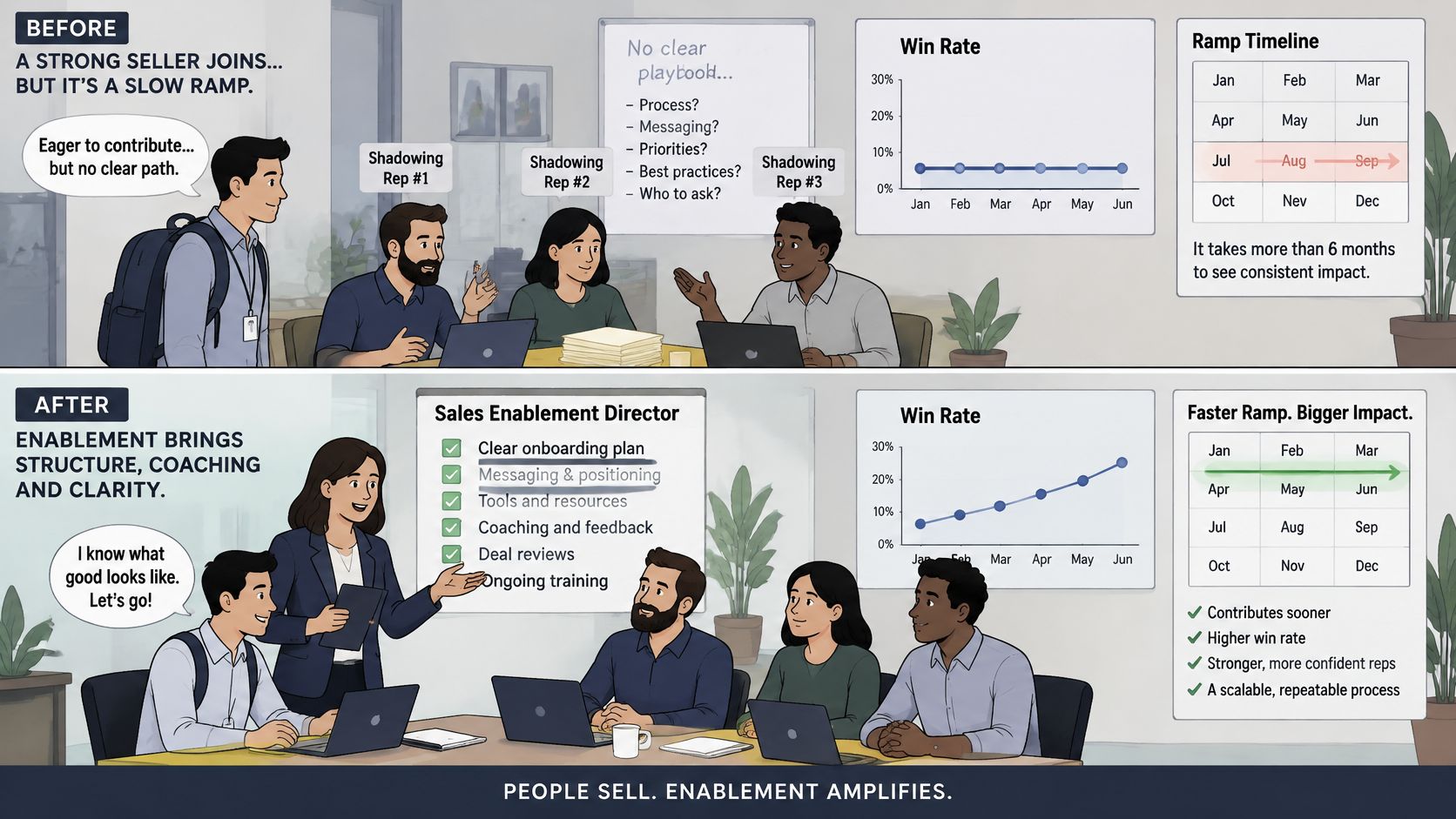
Think stage manager, not performer. The director doesn't deliver the show. They keep rehearsals, cues, and props in order so every seller can deliver the same scene well, with room for their own style.
A Relatively New Role
Formal enablement functions were rare before the 2010s. CSO Insights research reported in sales enablement statistics from Market Intelligence Tools found fewer than 20% of organizations had a sales enablement function in 2013, adoption rose to 59.2% in 2017, and it reached 61.3% in 2019.
The role usually reports into sales leadership and works alongside sales managers, marketing, and revenue operations. It typically doesn't carry quota. Owners who want practical program design can also borrow from sales training guidance for L&D teams, but a director isn't just a course creator, and they aren't a sales manager under another title.
Quick test: Who owns onboarding, who owns the playbook, and who reports ramp time?
Silence on any one of those questions shows the gap this hire is meant to fill.
Seven Responsibility Areas at a Glance
| Responsibility area | What the director does | Typical output |
|---|---|---|
| Sales catalyst | Drives adoption of new selling motions and behavior change | Rollout plan and adoption dashboard |
| Education and training design | Builds curricula tied to real deals and buyer stages | Role-based learning paths |
| Content marketing | Turns product and customer knowledge into sales content | Playbooks, battlecards, asset library |
| Metrics management | Defines measures that show whether enablement works | Scorecard with leading and lagging metrics |
| Onboarding improvement | Finds where new sellers stall and shortens ramp | Ramp plan with milestone checkpoints |
| Sales operations advancement | Improves CRM hygiene, stage definitions, sales process | Stage criteria and CRM field standards |
| Marketing strategy contribution | Aligns messaging and lead handoffs with marketing | Shared messaging framework and lead definitions |
Those seven areas aren't a wish list. A 2024 academic content analysis of 131 director-level sales enablement job postings identified them as recurring expectations, and the same study found directors act as internal and external liaisons, provide leadership, and solve problems systematically. It also cited a global survey of 371 firms across 24 industries in which 85% reported sales enablement initiatives, defined as deploying at least three enablement functions.
How Each Area Shows Up in Practice
As a sales catalyst, the director gets a new discovery motion used in live deals, not just announced at kickoff. In education and training, they design practice around buyer stages. For content marketing, they turn a product launch into a usable playbook and battlecard, then retire assets sellers ignore.
Metrics management means setting the scorecard before launching anything. Onboarding improvement means comparing ramp data across hiring cohorts to find where sellers stall, week two product knowledge, first solo call, or first proposal. Sales operations work includes tightening CRM stage definitions so a forecast stage means the same thing on every team. Marketing strategy means agreeing on messaging and lead definitions before sellers complain that handoffs don't match the pitch.
Where to Start
Pick the two areas closest to your revenue gap. A company with slow ramp needs onboarding and manager coaching first. A company with weak forecasts needs sales operations and metrics first.
Some areas, building a scorecard, tightening stage criteria, or drafting a playbook, can be scoped as a project. Coaching adoption and behavior change depend on daily presence inside the team. That split should drive your hiring decision later.
Building Onboarding and Coaching That Changes Behavior
A gym class teaches the lift. A trainer who watches every set is what makes the lift stick. Training works the same way.
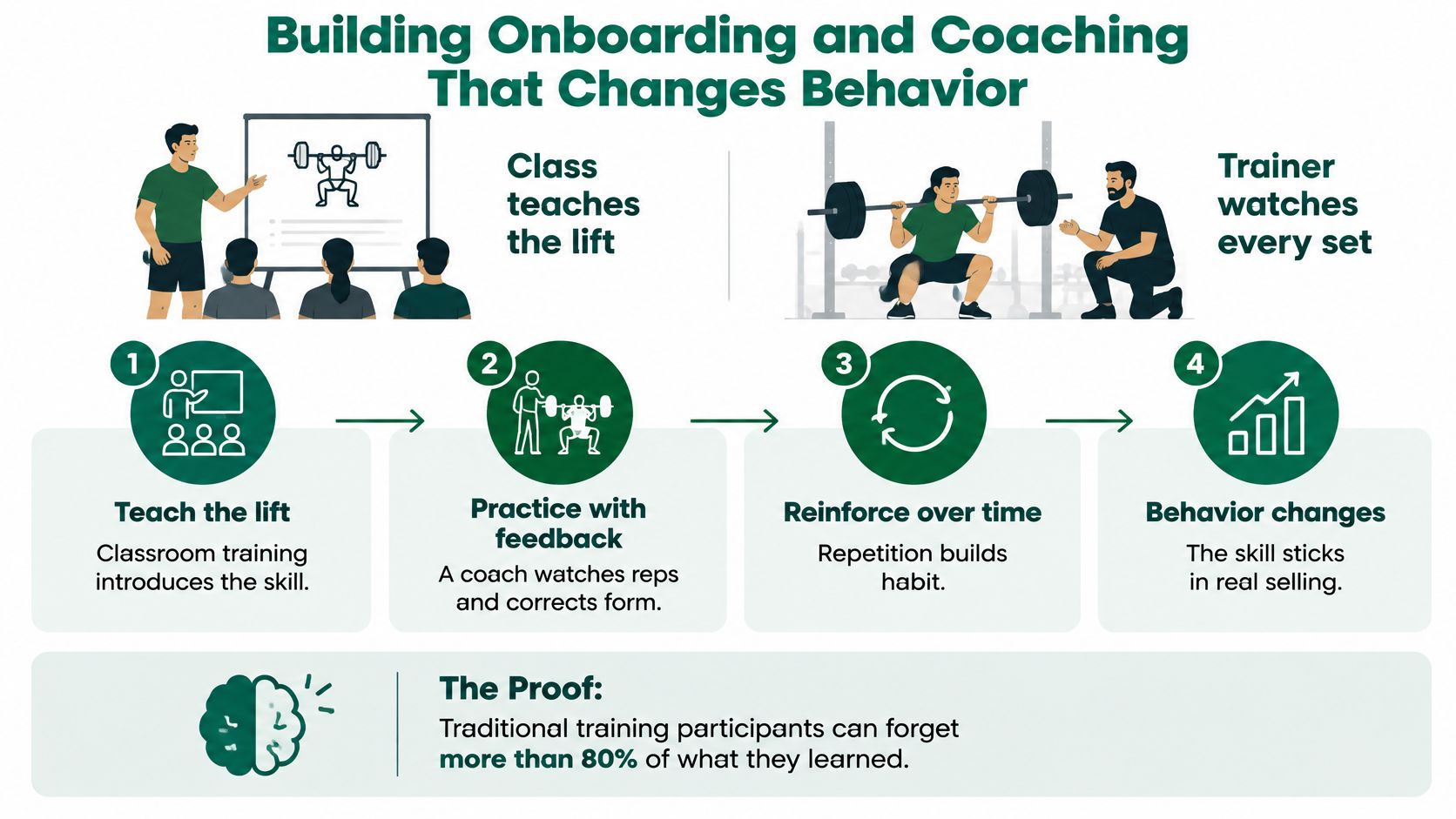
Harvard Business School summarizes evidence that traditional training participants can forget more than 80% of taught information within 90 days. A Wilson Learning research report found a 43% performance improvement from sales training alone versus 67% when manager coaching was added.
The Six-Step Build
- Map each module to a CRM stage: Discovery training belongs at qualification, business-case training at evaluation. The common slip is building neat modules no stage links to, so reps can't find help when a deal needs it.
- Write role-specific playbooks from real deals: Use won and lost call examples, actual objections, and your exit criteria. Generic playbooks get skimmed once. If you're also ramping technical pre-sales staff, use dedicated guidance to plan Solution Engineer ramp timelines alongside seller milestones.
- Run weekly call reviews: Each manager scores one recording against the playbook, one strength and one correction. The slip is turning reviews into deal inspection, where nobody practices the skill. For technique ideas managers can reuse in those sessions, see high-impact sales training techniques that reinforce skills in live selling.
- Set a fixed coaching cadence: Give every one-to-one a short agenda, last week's behavior, this week's focus, one live deal to apply it to. Coaching is the first thing cut when quotas tighten, so protect the slot.
- Certify observed behavior, not quiz scores: A rep passes by running a discovery call to standard in role play or on a recorded call. Quizzes prove recall, not execution under pressure.
- Recheck at 90 days: Re-score the same skills to catch decay early. If scores fell, the fix is usually more manager reinforcement, not another course.
This short walkthrough shows how practice and feedback fit together in a coaching session.
Can every manager name what to coach this week for each rep? If not, you don't have a reinforcement system yet.
Measuring Enablement With Leading and Lagging Metrics
| Metric tier | Typical measures | What it tells you |
|---|---|---|
| Leading (skill) | Certification results, manager-observed skill ratings | Whether reps can perform before they sell |
| Intermediate (behavior) | Activity quality, stage conversion, pipeline-to-quota coverage | Whether new behavior reaches the pipeline |
| Lagging (outcome) | Win rate, ramp duration, quota attainment, revenue | Whether enablement changed results |
| Diagnostic (adoption) | Training completion, content utilization, technology adoption | Whether tools are used, weak proof of impact alone |
Read the table top to bottom. Certification and manager-observed skill ratings move first. Activity quality, stage conversion, and pipeline coverage show whether that skill reaches live deals. Win rate, ramp duration, quota attainment, and revenue confirm the result, weeks or months later.
For context on ramp, SBI's 2025 benchmark of 134 companies reports a mean seller ramp time of 3.5 months, while nearly 24% of teams expect sellers to require six months or longer to reach productivity.
Why Tiers Matter
When win rate falls, tiers help you locate the cause. Strong certification scores but weak stage conversion point to execution or process design. Weak skill ratings point to knowledge. Strong skills on one team only point to manager adoption. Weak results everywhere, including veterans, may point to market conditions, not enablement.
The common error is treating content downloads or course completion as proof of commercial impact. They're diagnostic only. They tell you something was opened, not that selling improved.
Before reading any change, set a pre-intervention baseline and a matched comparison group where possible. Then separate enablement's effect from pricing changes, product changes, seasonality, manager behavior, and rep experience. If you want a plain-language primer for non-analysts, The OKR Hub's execution metrics guide explains leading indicators well, and a RevOps perspective on choosing business metrics helps connect them to revenue reporting.
The Quarterly Review
Compare cohorts hired in different quarters. Control for tenure and territory. Link each intervention to a CRM-defined behavior change before claiming a revenue effect.
The director should bring the chief revenue officer a one-page scorecard, three leading measures, two intermediate, and two lagging, each with an owner and a target. Anything longer won't get read.
Why Enablement and Sales Leaders Often Misalign
In 2025, 51% of sales enablement practitioners reported that they were not aligned with organizational leadership on metrics and measurement, according to Sales Enablement Collective. That isn't a reporting problem. It's a problem that starts before the first course is built.
Say a director presents course completions to the leadership team. The CFO asks what changed in pipeline. The room goes quiet. The fix isn't a better dashboard. It's agreeing on the question before the course launches.
Three Moves That Close the Gap
- Agree on outcomes first: Pick two or three with the chief revenue officer, such as ramp time, stage conversion in the first 90 days, or quota attainment of new hires. If everything's a priority, enablement is accountable for nothing.
- Write a one-page measurement agreement: State the baseline, the comparison group, and the review date. Sign it before work starts, so nobody moves the target after results arrive.
- Report in commercial language: Sales and finance care about capacity added, cost of delay, and pipeline per rep. Translate skill gains into those terms, or they'll be treated as training trivia.
There's a second alignment problem underneath this one. Enablement supplies the system, but managers run it every day. A director who reports rep outcomes without manager adoption can't tell whether the program failed or never reached the field.
Watch for these signs: Content requests arrive with no stated outcome. A dashboard exists that nobody opens. A sales leader insists the team is fine while ramp time keeps rising.
Any one of those means the director's first job isn't building content. It's closing the measurement gap with leadership.
Skills and Traits That Separate Strong Directors
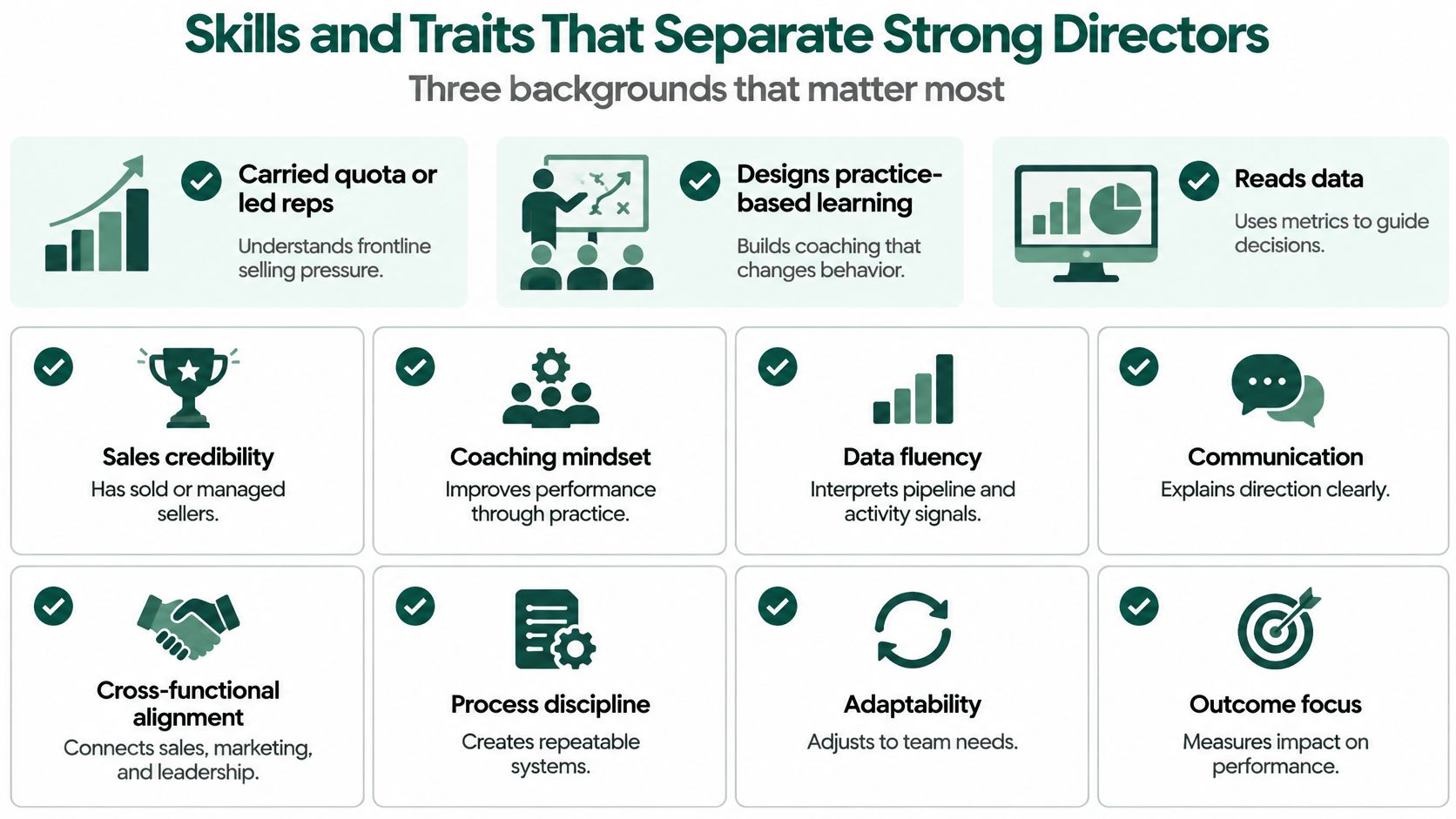
Strong directors combine three backgrounds. They've carried quota or led reps, they can design practice-based learning, and they can read data. Miss any one and the role tilts, toward theory, toward content production, or toward activity reporting.
Interview Checklist
- Field credibility: Has sold or managed reps in your motion. Probe by asking about a lost deal and what changed afterward.
- Instructional design: Builds practice, not lectures. Probe by asking which module they retired and why.
- Data fluency: Builds cohort comparisons and separates signal from noise. Probe by asking how they'd prove training helped when territories differ.
- CRM judgment: Knows which fields drive forecasts. Probe by asking for the first CRM field they'd clean.
- Influence without authority: Persuades managers who own their teams. Probe by asking how they got a skeptical manager coaching weekly.
- Content judgment: Spots messaging buyers ignore. Probe with a live battlecard review during the interview.
- Change management: Sequences rollouts so reps keep selling. Probe by asking about a rollout that stalled and how they recovered it.
- Systematic problem solving: Diagnoses before prescribing. Probe by asking what they'd check in week one before recommending anything.
Strong candidates answer with numbers and specific failures. Weak candidates list tools they've administered and courses they've shipped. I'd weight the failure stories heavily, because this job is mostly fixing systems that looked fine on paper.
Decide Between a Full-Time Director and a Fractional Leader
Start with a direct rule. If you don't yet know whether your gap is enablement, sales operations, or sales leadership, run a diagnostic before hiring anyone. If the gap is clear and permanent, hire the owner. If the gap is clear but scoped, fractional leadership is usually faster.
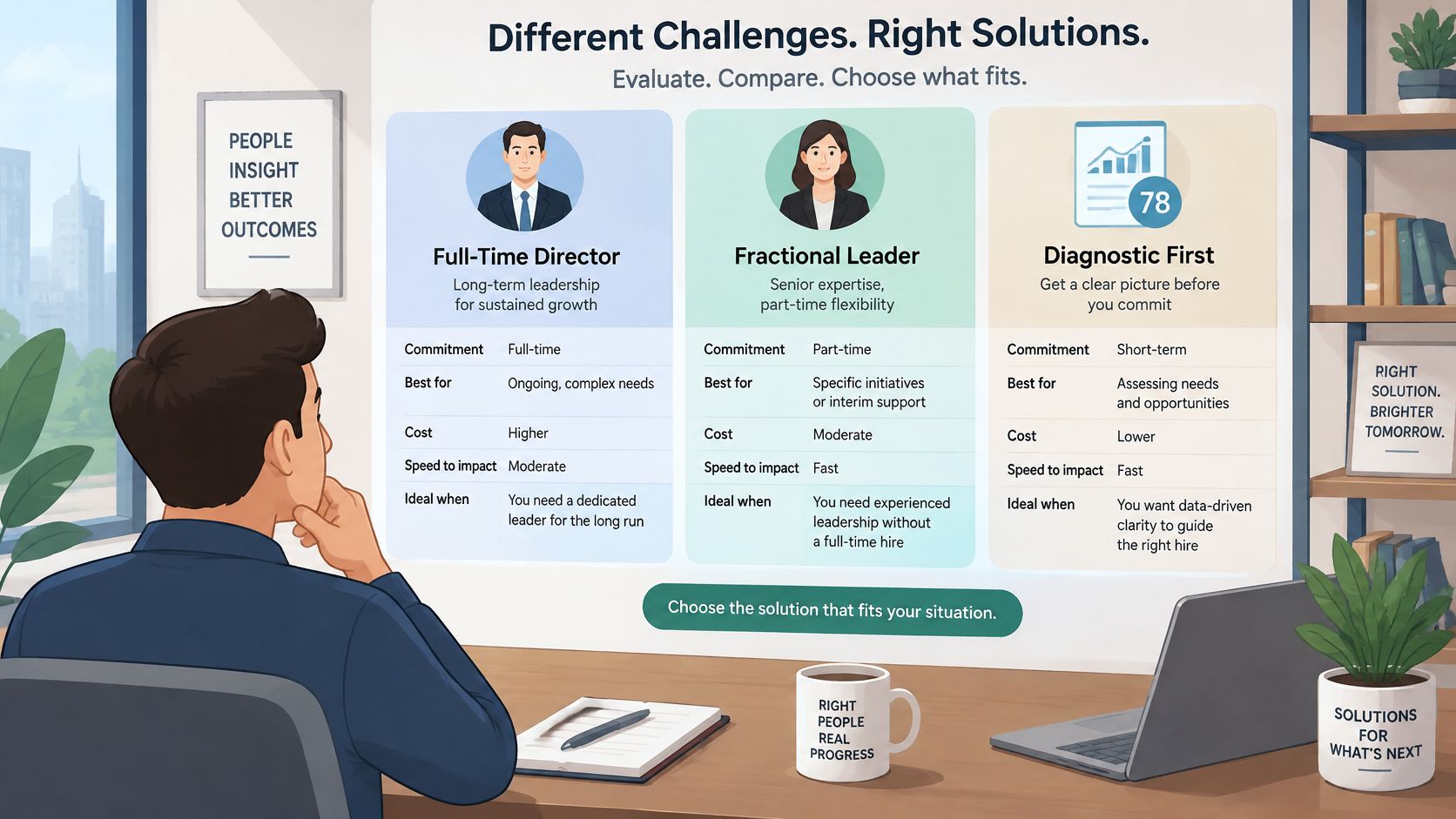
| Situation | Better fit | Why |
|---|---|---|
| Ramp time is long and no one owns enablement metrics | Director-level owner, full-time or fractional | The gap is ownership, so you need an accountable leader first |
| New product or market with a short window to show a business case | Fractional leader | A scoped engagement can set a baseline and report early results |
| Steady growth, budget for a permanent senior hire, no clear scope yet | Full-time director | Ongoing ownership of systems, team development, cross-functional work |
| Unsure whether enablement, sales operations, or RevOps is the gap | Run a diagnostic first | The diagnostic shows which role and fix the metrics point to |
The diagnostic is the scorecard approach applied once. Measure ramp, stage conversion, and manager coaching activity, then see which one explains your revenue gap. If ramp is long and nobody owns the numbers, you need an owner before you need more content.
A fractional engagement should be a scoped project with a defined outcome, embedded in the team with daily standups and weekly reviews, and accountable to your sales metrics. For a comparable senior model, see how to assess an outsourced VP of Sales on role and cost.
Revenue Nomad is a marketplace for fractional sales, revenue, and marketing leaders. Our Fractional Sales Management services design and implement your sales strategy, coach your team, and drive predictable revenue growth without a full-time hire, and a Fractional Sales VP is available to start within 7 days. That fits a leadership gap more than a pure enablement gap, so ask any candidate or provider to show a ramp-time or enablement case before you engage.
Before any conversation, write a one-page scope, team size, current ramp time, the three metrics you'll report, and the first 90-day outcome. Take it into every interview. Candidates who can't work to it aren't your director.
If you're deciding between hiring a sales enablement director and bringing in fractional leadership first, we can help you scope the gap and match you with a vetted operator who owns ramp, coaching, and measurable seller performance. Visit Revenue Nomad to compare profiles and start a scoped engagement built around your revenue targets.