
Head of Revenue Operations: Role, Duties and Skills
Learn what a head of revenue operations does, the core duties and skills the role needs, how it differs from sales ops, and when a company should hire one.

Your sales leader reports one number for the quarter. Your finance lead has a lower one, because two contracts still aren't countersigned. Marketing is quoting a pipeline figure nobody in the room recognizes. Nobody is lying. Each team is reading a different system, with a different definition of when a deal counts.
That gap is why the head of revenue operations role exists. Not to referee an argument about whose number is right, but to build one set of definitions, one data model and one forecast rhythm that every revenue team works from.
The role carries more than most founders expect and less than most newly promoted heads assume. Getting that boundary right is the difference between a revenue system you can forecast from and an expensive set of dashboards.
Table of Contents
- What a Head of Revenue Operations Owns
- How the Role Differs from Sales Ops and the CRO
- Keeping CRM Data Trustworthy Enough to Forecast
- Forecast Governance and the Metrics That Matter
- Governing AI and Automation Before They Touch Revenue
- Skills and Experience to Look For in a Candidate
- Decide When to Hire a Head of Revenue Operations
What a Head of Revenue Operations Owns
A head of revenue operations makes revenue run as one system. The role owns the processes, data, systems and metrics that connect marketing, sales and customer success, so the same deal is described the same way in every meeting.
The cleanest split from sales leadership is this. Sales leaders decide where the team goes: which segments to attack, which deals to chase, which reps to hire. The head of revenue operations keeps the machinery running and the numbers honest, so the people making those calls work from a system that produces a trustworthy answer. Ownership works like a building here. Data sits in the foundation, process and systems rest on top of it, and the forecast only holds weight when everything underneath is sound.
The remit is wider than most job descriptions admit. In a survey of revenue-operations professionals published in the Salesforce State of Sales report, 92.25% named metrics and key performance indicators as part of their responsibilities, 78.29% named pipeline strategy, and 76.74% managed the technology stack. Seniority stretches the job further: 100% of senior respondents claimed metrics and KPIs, and 80.77% counted reducing go-to-market time waste as part of the work, against 55% of junior professionals. The survey's lineage data explains the shape of the role. 45.74% of respondents worked in sales operations before moving into revenue operations, which is why the function reads as sales operations extended across all three revenue teams rather than a brand new discipline. The measures it gets judged on follow the same pattern: ARR/MRR, tracked by 79.84% of respondents, close rate by 68.99%, and revenue retention by 65.89%, with retention measurement up 20.79% on the prior year.
The six areas the role actually carries
| Responsibility area | What the leader owns | Typical output | Metric to track |
|---|---|---|---|
| Metrics and KPIs | Metric definitions, dashboards and executive reporting | KPI dictionary and weekly revenue dashboard | ARR/MRR, close rate and revenue retention |
| Pipeline management | Stage definitions, exit criteria and pipeline inspection | Stage exit criteria and pipeline review cadence | Pipeline coverage and stage conversion |
| Technology stack | CRM, sales engagement and enrichment tools and how they integrate | Integration map and admin standards | Data completeness and tool adoption |
| Forecasting | Forecast process, categories and review cadence | Commit, best case and upside forecast with inspection schedule | Forecast accuracy and bias |
| Territory and compensation data | Territory inputs, quota data and capacity assumptions | Territory plan and quota data model | Quota attainment spread |
| Cross-team handoffs | Lifecycle stages and marketing-to-sales-to-customer-success handoffs | Lifecycle definitions and handoff service levels | Lead-to-opportunity and opportunity-to-close conversion |
Look at what sits in that table and what doesn't. Report building isn't a responsibility area. A dashboard is an output of these six, and it's only as good as the definitions underneath it. That ordering matters more than it first appears. A head of revenue operations who inherits a CRM full of inconsistent fields and automations nobody documented spends the first stretch of the job rebuilding trust in the data, because every metric, forecast and handoff downstream inherits whatever quality the foundation has.
The boundary worth drawing early is between what the role owns, what it influences and what it refuses. It owns how a deal is defined at each stage, how the systems connect and how the forecast gets called each week. It influences territory design and compensation data, where finance and sales leadership hold final authority but depend on clean inputs to decide well. And it refuses work that bypasses the system: report requests that contradict agreed definitions, tool purchases that duplicate the stack, side spreadsheets that become shadow pipelines. A head of revenue operations who can't decline those ends up running a help desk instead of a revenue function.
How the Role Differs from Sales Ops and the CRO
Most confusion about this role comes from overlapping titles, not overlapping work. Put the three jobs side by side and the boundaries get obvious.

The chief revenue officer owns the revenue target and is accountable for hitting it across sales, marketing and customer success. That's a number-and-strategy job. The head of revenue operations owns the end-to-end revenue process, the data model, the system integrations and the forecast cadence that produce the number the CRO is accountable for. One decides, the other makes the decision survivable.
Below that line sit two narrower roles that get confused with the head of revenue operations constantly. The sales operations manager runs day-to-day sales tooling, territory administration and quota changes, usually reporting to a sales leader. The marketing operations manager runs marketing automation, lead routing and campaign data, usually reporting to a CMO. Both are specialists in one lane.
| Role | Core scope | Typical reporting line | Question it answers |
|---|---|---|---|
| Chief Revenue Officer | Revenue targets and accountability across sales, marketing and customer success | Usually the CEO | Will we hit the number? |
| Head of Revenue Operations | Processes, data, systems and forecast cadence connecting all revenue teams | COO, CEO or CFO, depending on the company | Does the revenue system produce reliable numbers? |
| Sales Operations Manager | Sales tooling, territories, quota administration and day-to-day CRM work | Sales leader or head of revenue operations | Is the sales team set up to execute? |
| Marketing Operations Manager | Marketing automation, lead routing and campaign data | CMO or head of revenue operations | Are leads flowing and measured correctly? |
The reporting line is the least standardized part. A head of revenue operations can sit under the COO, the CEO or the CFO, and in smaller companies the same person often carries the sales ops load too. Where the two functions are still merged, this breakdown of RevOps versus sales ops and what each does to pipeline conversion and retention is a useful way to decide whether it's time to split them.
Rule of thumb: the CRO asks whether the number will be hit. The head of revenue operations asks whether the system can be trusted to produce the number. The sales ops manager asks whether the team is set up to execute. If your head of RevOps is spending the week on quota admin, one of those three questions is going unanswered.
Keeping CRM Data Trustworthy Enough to Forecast
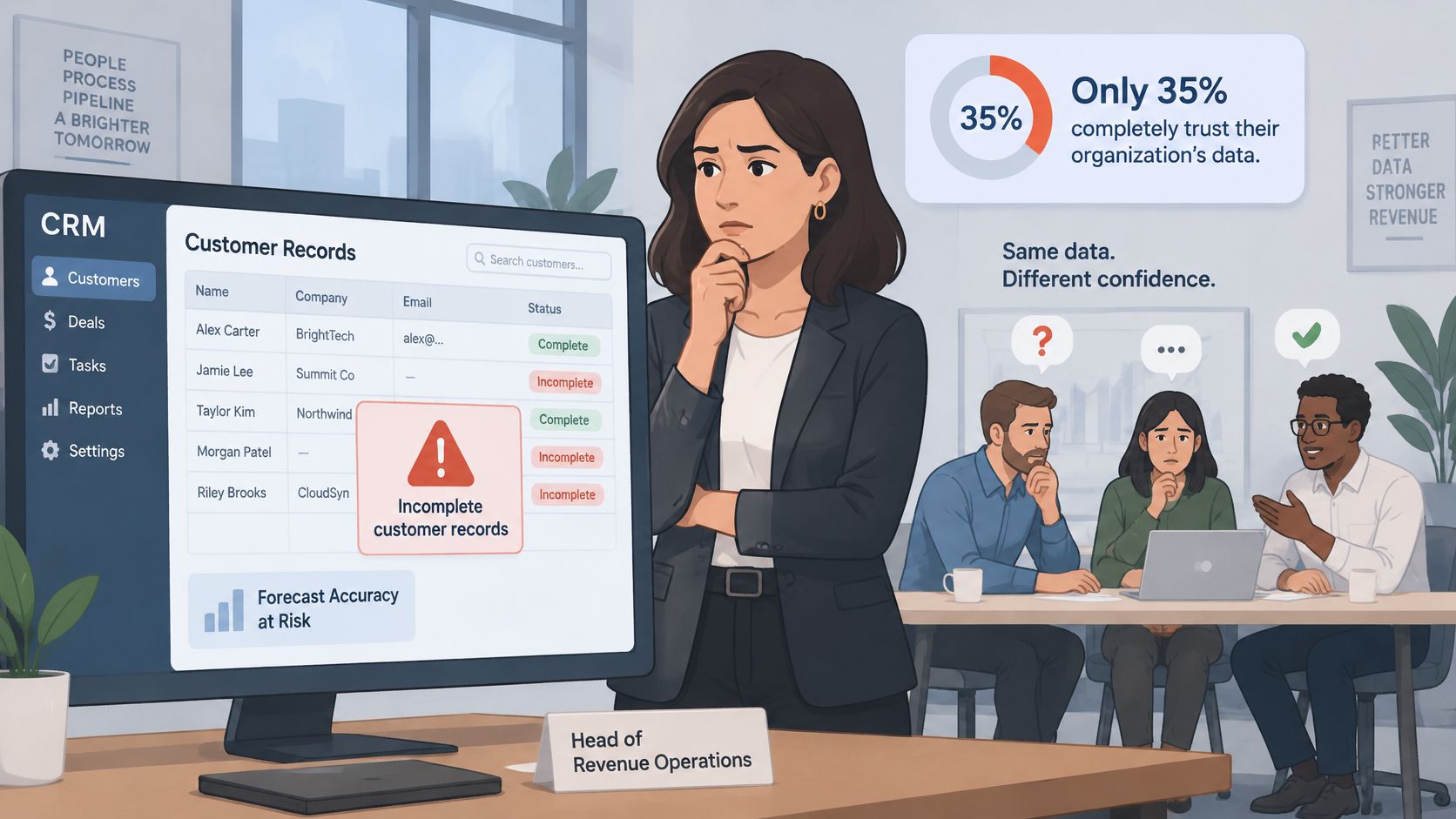
Data quality isn't housekeeping. It's the control system the forecast rests on, and most organizations know it's failing. In Salesforce's global State of Sales survey of 5,500 sales professionals, only 35% said they completely trust the accuracy of their organization's data, and respondents named inaccurate or incomplete data as a barrier to forecasting, performance management, quota setting and competitive analysis, as reported in the State of Sales research.
The mechanism is mechanical, not cultural. A missing amount or a stale close date distorts the weighting of every deal in the pipeline. Stage definitions that differ between regions make conversion math incomparable, so a manager in one territory looks efficient and another looks slow when the difference is which fields their reps bother to fill in. When a large share of the pipeline is under-described, the roll-up isn't a forecast. It's an average of guesswork.
The six-step sequence
- Define the required opportunity fields. Amount, close date, stage, next step and recent activity. Five fields, no exceptions by team.
- Add validation rules that block saving an opportunity without them. A warning banner is a suggestion. A blocked save is a control.
- Assign ownership by object and field. Every required field has one named owner accountable for its completeness, not a committee.
- Standardize stage definitions with written exit criteria, so "proposal" means the same thing in every region.
- Deduplicate accounts and contacts on a schedule. Weekly or monthly, with a merge log, not a one-off cleanup project.
- Build a recurring exception dashboard that lists records breaking the rules before anyone reviews a forecast.
Then measure it. Track completeness and freshness by segment, and report the defect rate next to the forecast result in the same review. That single change moves CRM hygiene from periodic manual cleanup to an operating KPI, and it's the difference between a data initiative that lasts a quarter and one that holds.
A worked version of step six: an opportunity worth six figures has no next step recorded and its close date has slipped twice in six weeks without a stage change. It gets flagged in the exception report two days before the forecast call and stays out of commit until someone fixes the record or downgrades it to best case. Salesmotion's guide to CRM data quality goes deeper on field-level scoring if you want to sequence the cleanup work.
Forecast Governance and the Metrics That Matter
A forecast is a process output before it is a prediction. Ask sales leaders why their number missed and the answer traces back to the same root almost every time: the records feeding the forecast were incomplete, inconsistent or stale. Poor data quality undermines forecast accuracy before any model or manager gets a chance to. Ungoverned inputs are the problem, not weak tooling.

Governed inputs come first
A forecast you can defend is built from four components. Consistent stage exit criteria, so a deal only advances when something verifiable happened. Documented probability logic, so weighting reflects evidence instead of a rep's mood. A close-date policy that forces a reason when a date moves. And a fixed inspection cadence, so the same questions get asked every week instead of only in the last three days of the quarter.
Then keep the three pipeline categories separate: commit, best case and upside. Merging them into one optimistic number destroys the only signal executives need, which is how much of the forecast depends on things going right. This is also a decision the head of revenue operations should own outright rather than negotiate: sales leaders will always argue for a softer commit definition, and the role exists to hold that line.
Score the forecast against what happened
Signal quality improves when you track historical conversion rates by stage, segment, source and seller tenure, because those four cuts explain most forecast misses. Score each forecast version against actual bookings using bias (are you consistently high or low?), absolute error (how far off, in dollars?) and attainment. A team that is systematically optimistic by 12% does not need better software. It needs to apply a calibration factor and find out why the pattern repeats.
Cause and effect run in one direction. Deals that stay open past the normal sales-cycle duration, and close dates that slip without a stage change, both push the aggregate forecast upward. Nobody lies. The structure of the data does it.
Run these four exception flags before every executive review: aging deals past your median cycle, opportunities with no activity in 21 days, records with a missing next step, and any amount change above your deal-size threshold. Each flag is a question the forecast should have answered already.
Forecasting software speeds up detection, and if you are comparing options, this roundup of sales forecasting platforms scored and priced will save you a week of demos. No tool compensates for inconsistent definitions or half-empty records. Governance, validation and retrospective calibration are what convert pipeline data into something a board can act on, which is also why the metric set itself has to be chosen deliberately, as this look at how RevOps teams pick the metrics that drive decisions argues.
Governing AI and Automation Before They Touch Revenue
The job posting usually says the new hire will deploy AI across the revenue funnel. The first useful thing that person does is often the opposite: switch off an automation running unsupervised, or refuse to turn one on until the data underneath it holds.
The readiness numbers support the caution. Among 157 B2B revenue, marketing and sales-operations leaders, 55% named data quality as the biggest AI challenge, 70% said poor data hygiene had already degraded execution, and 94% said their go-to-market infrastructure was not AI-ready, according to the 2026 State of AI Go-to-Market Readiness report from LeanData. Data cleaning and automated workflows are where teams start, which makes sense. They're also where bad inputs do the least visible damage.
Split the work by risk, not by enthusiasm
Deduplication, summarization and administrative automation can go live early with an audit log and a rollback path. Decisions that move money or change who a customer hears from need controls first.
| Task | Risk tier | Control required before launch |
|---|---|---|
| Deduplication | Low risk | Automated with an audit log and a rollback path |
| Summarization | Low risk | Spot-check sampling by a RevOps analyst |
| Administrative automation | Low risk | Logged changes and tested rollback |
| Lead prioritization | High risk | Minimum data standards, drift monitoring and a human review threshold |
| Territory assignment | High risk | Identity resolution and RevOps lead approval before any change |
| Forecast commit | High risk | Calibration check and human sign-off before each review |
| Automated customer messaging | High risk | Human approval for every template and an audit trail |
Before any model influences routing, forecasting or outreach, the controls that need to exist are minimum data standards, identity resolution, required CRM fields, audit trails, human approval thresholds for high-risk actions, model-drift monitoring and a rollback procedure you've tested.
Drift is the one teams skip. Say a routing model sends leads by territory and someone renames the region field during a CRM cleanup. Leads start landing with the wrong owner, response times climb, and nobody notices for three weeks because the model still returns a confident answer. Drift monitoring catches that the same day by tracking routing accuracy against a known sample.
The head of revenue operations creates more value by documenting a process and stopping unsafe automation than by launching another tool. Tool count is not a KPI.
Measure error rates, routing accuracy, forecast calibration, adoption and hours saved. If AI agents are reaching into finance or customer data anywhere in your stack, this review of AI agent security risks in finance is worth reading before you widen their permissions.
Skills and Experience to Look For in a Candidate
Strong candidates stack three layers of skill, and most hiring managers only interview for the first.

The three layers
Technical depth. CRM administration at a level where they can build the validation rules themselves, data modeling, attribution logic, dashboard building, analytics, and a working grasp of how the integration layer connects the stack. Someone who has never rebuilt a CRM data model will inherit yours and preserve its problems.
Process design. Writing stage definitions with exit criteria, designing a forecast cadence, mapping lifecycle handoffs, and deciding who has decision rights when marketing and sales disagree about a lead.
Cross-functional authority. The role usually fails here. The head of revenue operations has to influence sales, marketing and finance leaders who don't report to them, tell a CRO the forecast is soft, and hold a line when a team resists a new process. Many arrive from sales operations, marketing operations or finance analysis. The gap they have to close is rarely tooling. It's authority.
A scoring checklist for hiring managers
- Has rebuilt a CRM data model, not just administered one.
- Has owned a forecast process end to end, including the review meeting.
- Has shipped a cross-team process change and can describe who resisted and how it was resolved.
- Has explained a forecast miss to a CEO without blaming the reps.
- Has said no to a tool or automation, with a reason that still sounds right a year later.
Then use one interview question as the test: ask them to walk through a forecast miss. What did the data show, which control would have caught it earlier, and who would they have needed to persuade to put that control in place? You'll hear within about four minutes whether they think in systems or in excuses.
Decide When to Hire a Head of Revenue Operations
The signals that you need this role are usually operational, not strategic. Finance rebuilds the quarter in a spreadsheet because the CRM can't be trusted. Forecasts hold until the last week and then collapse. Sales-cycle length moves without anyone able to explain why. Three teams present three versions of the same pipeline.
Scope is the part most companies get wrong, and the market knows it. A 2025 survey of 400 U.S. RevOps and executive decision-makers found that 98% said RevOps scope had expanded, while 89% said the function lacked clearly defined strategic goals, with leaders distributed across the COO, CEO and CFO organizations rather than following one reporting model, as this analysis of the undefined RevOps job description details. The investment appetite is there: in 2025, 87% of surveyed companies planned to increase investment in revenue operations, according to Salesloft's Wakefield Research study.
| Company stage | Likely scope | Typical hiring pattern |
|---|---|---|
| Pre-seed and early seed | Hands-on systems build: CRM setup, lead capture and first revenue reporting | Fractional or founder-led, with a full-time hire later |
| Series A | Lifecycle definitions, forecasting process and first sales-team cadence | Fractional or first full-time hire |
| Scaling company | Cross-functional operating cadence, capacity planning and governance of data and AI | Full-time head of revenue operations |
| PE-backed or post-acquisition | Standardized reporting and integration of acquired revenue systems | Full-time, often with a revenue operations team |
The failure mode is predictable. Hire a head of revenue operations without decision rights and you get more meetings and more tooling, not better revenue, because the person can see the problem and can't change the process that causes it.
So before you post the role, write down which decisions it will own, which it will influence, and which it will explicitly refuse to own. Cover CRM governance, territory design, forecasting, compensation data, marketing attribution and customer handoffs. Then set success measures that mean something: forecast accuracy, data completeness, sales-cycle friction and time-to-productivity by segment.
If you need help before a full-time hire is justified, a fractional operator can run that RACI and the first forecast cycle, and this guide to the revenue operations consultant role and when to hire one sets out how those engagements are usually scoped. Revenue Nomad lists revenue operations operators by business stage and area of expertise, and the process is simple: request an intro, complete a short intake, and get a warm connection to someone who has done the work.
If your revenue numbers still disagree across teams, the missing piece is usually an operating layer, not another tool. Revenue Nomad connects companies with fractional revenue operations leaders who build the definitions, forecast cadence and data controls described here, matched to your stage and immediate priorities. Visit Revenue Nomad to browse operator profiles and request an introduction.