
How to Deploy Sales Enablement Across a Revenue Organization
Learn how to give sales enablement the mandate, authority, cross-functional reach, and measurement needed to improve revenue performance over time.
Sales enablement cannot make a lasting difference if its remit begins and ends with training requests. To improve revenue performance, it needs a clear mandate, authority over how changes reach sellers, access to the teams that shape the customer journey, and goals that leadership agrees to measure over time.
That does not mean enablement owns every revenue outcome. It means the revenue organization gives it a defined role in changing seller and manager behavior, then holds it accountable for the adoption and performance signals it can reasonably influence.
Table of Contents
- Start With a Revenue Problem, Not an Enablement Team
- Give Enablement a Charter and Decision Rights
- Build Reach Across the Revenue Organization
- Make Managers Part of Deployment
- Measure Behavior and Business Results Over Time
- Deploy in Phases and Review the Mandate
Start With a Revenue Problem, Not an Enablement Team
Before creating an enablement function, name the performance problem it is supposed to help solve. Perhaps new sellers take too long to become productive, product launches fail to change deal conversations, or managers coach inconsistently across regions. Each problem calls for different partners, interventions, and measures.
Define the scope in terms of who must change behavior: new-business sellers, account managers, frontline managers, or customer-facing teams across the full lifecycle. Then agree where enablement will focus first. A broad mandate without priorities can quickly turn into an inbox for every training and content request.
The distinction matters because training is an activity; enablement is an operating system for getting useful skills, messages, and tools into everyday revenue work. For a plain-language introduction to the discipline and its tools, see The Social Search's overview of sales enablement tools and training.
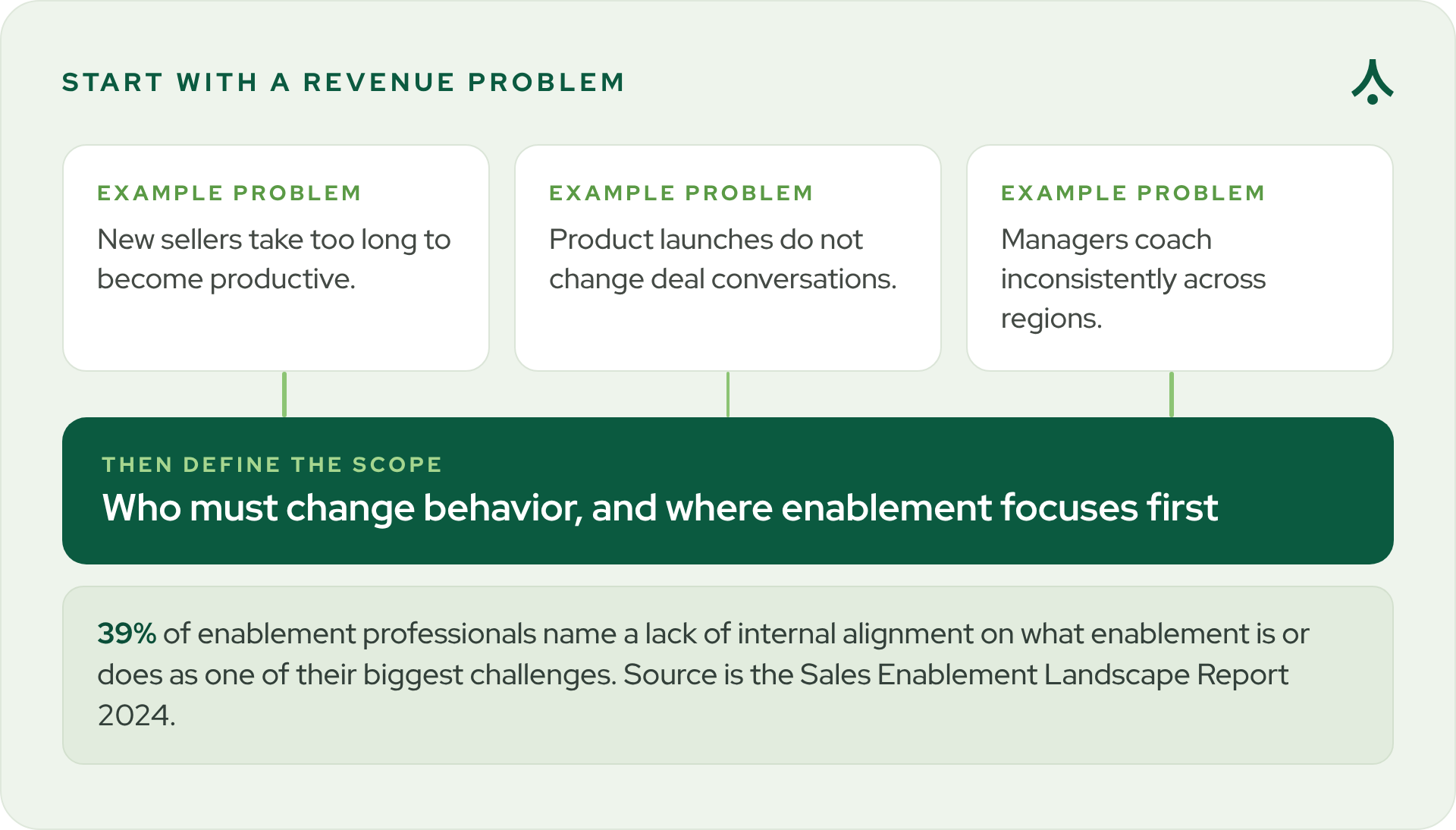
The need for definition is not theoretical. In the Sales Enablement Collective Sales Enablement Landscape Report 2024, 39% of surveyed enablement professionals identified a lack of formal internal alignment on what enablement is or does as one of their team's biggest challenges. Write down the mandate before expecting the function to change outcomes.
Give Enablement a Charter and Decision Rights
A charter should be short enough to use in a planning meeting. It should name an executive sponsor, the revenue priorities enablement supports, its target teams, its partners, its authority, and the measures by which the work will be reviewed. The sponsor's job is to resolve competing priorities when functions disagree, not merely approve a budget.
Authority does not mean owning every adjacent function. It means having a defined say in decisions that determine whether an initiative reaches the field and sticks. Agree who can prioritize requests, approve a launch plan, set readiness criteria, require manager reinforcement, retire outdated assets, and pause a rollout that is not ready.
| Decision | A workable division of responsibility |
|---|---|
| Revenue priority and outcome | Revenue leadership sets the commercial goal and resolves trade-offs. |
| Message and product claims | Product marketing or the relevant product owner approves accuracy; enablement designs field application. |
| Workflow and reporting | Revenue Operations owns system definitions and data integrity; enablement specifies the adoption signals it needs. |
| Seller readiness and rollout | Enablement designs practice, reinforcement, and readiness checks with frontline managers. |
| Coaching and inspection | Managers observe behavior in live work; enablement equips them with prompts and feedback loops. |
The exact owners vary by company. What matters is that each decision has an owner and a route for resolving disagreement. If enablement is accountable for adoption but has no influence over launch timing, manager expectations, or the tools sellers use, its accountability is mostly symbolic. The guide to sales enablement director duties, skills, and results is useful when assigning leadership responsibilities.
Where the function reports is less important than whether the reporting line provides executive access, shared priorities, and a way to settle conflicts. The Sales Enablement Collective's discussion of the enablement alignment crisis notes that leadership and enablement teams often disagree about which metrics matter. Put that agreement in the charter, too.
Build Reach Across the Revenue Organization
Enablement needs working relationships with Sales, Marketing, Product Marketing, Revenue Operations, Customer Success, and whoever owns learning or people development. The purpose is not to create a standing committee for every request. It is to catch the handoffs where a good idea commonly stops short of customer-facing behavior.

For a product launch, Product Marketing may define the message, RevOps may update CRM fields and workflows, enablement may design practice and job aids, and sales managers may inspect calls and reinforce the new approach. Customer Success should be involved when the promise made during the sale affects onboarding or renewal. Without those connections, sellers receive a presentation while their daily workflow continues to reward the old behavior.
Set up a recurring planning forum with people who can commit their functions to work. Give it a shared backlog, a small number of prioritized changes, and an escalation route to the sponsor. Include frontline managers and customer-facing representatives early enough to test whether the proposed change works in real conversations.
This is also where boundaries with RevOps become practical. RevOps typically maintains systems, process definitions, and reporting integrity; enablement works on adoption, coaching, and behavior. Both need to agree on what will be instrumented before a rollout. For a closer look at that partnership, read the revenue operations consultant role, work, and when to hire. The broader decisions about markets, motion, and ownership belong in GTM planning; GTM planning and execution with H2 provides useful context.
Make Managers Part of Deployment
A launch is not complete when sellers finish a course. Sellers need to know what to do differently, have a chance to practice, see the change in the systems and assets they use, and get feedback while working real opportunities. Frontline managers are the bridge between a program and sustained field behavior.

Give managers a specific inspection and coaching task, not a request to "reinforce the training." If the goal is better discovery, define what a good discovery conversation sounds like, give managers a way to review examples, and ask them to coach against the same criteria. Confirm they have time and authority to do it. Otherwise, a team can report high training completion while continuing to sell the old way.
These high-impact sales training techniques offer methods to test inside that larger reinforcement plan. You can also compare your rollout checklist with Tutorial AI's sales enablement recommendations. Neither a training method nor a checklist substitutes for named manager ownership.
The video below provides a spoken introduction to the enablement role. Use it as background, then translate the role into concrete decisions and manager actions for your own organization.
Measure Behavior and Business Results Over Time
Start with a baseline and a hypothesis: If managers coach the new discovery approach and sellers use it in qualified opportunities, what should change first, and what commercial result might follow? Agree on the measures with revenue leadership before rollout, not after the numbers arrive.
| Measurement layer | Example questions | Example measures |
|---|---|---|
| Delivery and readiness | Did the right people receive and practice the change? | Participation, practice quality, readiness checks |
| Adoption and behavior | Are sellers and managers using it in real work? | Coaching cadence, observed call behavior, workflow or asset use |
| Operational performance | Is execution improving? | Ramp milestones, time to first qualified opportunity, stage progression |
| Commercial outcomes | Did revenue performance improve? | Win rate, sales-cycle length, pipeline quality, retention where relevant |
Completion alone is not impact, and a change in win rate alone does not prove causation. Compare like-for-like cohorts where possible, note changes in territory, pricing, product, and manager quality, and look for evidence along the whole chain from intervention to behavior to result. Review leading indicators frequently enough to adjust the rollout; judge lagging results over a period that fits the sales cycle.
This discipline addresses a common obstacle. The Sales Enablement Collective sales metrics guide reports that 61.2% of enablement professionals identify measuring impact and effectiveness as a major challenge. The 2024 landscape report also reports that only 51% said their teams and leadership agreed on which metrics to use. A shared scorecard is therefore part of deployment, not a reporting task to add later.
Deploy in Phases and Review the Mandate
Avoid launching a company-wide program before testing its operating model. A phased approach makes it easier to learn whether enablement actually has the access and authority promised in its charter.
- Choose one revenue problem and define the baseline. Select a segment, role, or motion where a change can be observed.
- Publish the charter and ownership map. Name the sponsor, functional partners, decisions, escalation path, and agreed measures.
- Pilot with managers and sellers. Test the message, practice, workflow changes, and coaching prompts in live work.
- Inspect adoption before declaring success. Ask what people did differently, what blocked them, and whether the measures captured it.
- Expand only what works. Adapt the intervention for other regions or roles rather than assuming the same rollout fits everyone.
- Review the mandate regularly. If the work depends on approvals enablement cannot obtain, fix the decision rights before adding more programs.
Professional communities can support the team developing this model, but they cannot grant internal authority. The Sales Enablement Collective about page describes a community with peer learning, events, certifications, and research. Those resources can help practitioners compare approaches and build skills; leadership still has to make the organizational decisions. Compare communities by what their audience figures actually count, rather than assuming a headline network size equals available peers. Certifications can support professional development, but they do not replace ownership of results. Confirm any membership tier, event, or certification details directly before paying for access.
Revenue Nomad lists operators across Sales Leadership, Marketing, Revenue Operations, Sales Enablement, Customer Success, Growth, AI GTM, Partnerships, and Sellers. That may be an option to evaluate if the immediate gap is hands-on implementation rather than professional learning. Whether the work sits with an employee or an external operator, use the same test: do they have a clear remit, access to the right functions, decision rights, manager participation, and an agreed way to measure progress?
The long-term goal is not a busier enablement calendar. It is a revenue organization that can introduce a change, get it adopted in daily work, see whether it improves performance, and adjust when it does not.
If you need implementation help, Revenue Nomad is one place to explore fractional revenue operators alongside an internal hire. Define the mandate and success measures before choosing either route.