
Sales Enablement Collective: What It Is and Who It Serves
Learn what the Sales Enablement Collective is, how its community, events and certifications work, and whether it suits your enablement role.
The Sales Enablement Collective is a professional community founded in December 2019 to unite revenue leaders around consistent, predictable revenue growth. If enablement is more than training decks and a content folder, where do the people who build it learn what good looks like, compare notes, and prove their skills?
That's the gap the Sales Enablement Collective, often shortened to SEC, was built to fill. It's not a software platform and it doesn't run your program for you. It's a place where enablement practitioners and revenue leaders exchange practice, study research, attend expert-led sessions, and earn credentials, so they can return to their own teams with clearer ideas and stronger evidence.
Table of Contents
- What the Sales Enablement Collective Is
- Community Scale in Numbers
- How the Collective Combines Five Formats
- Where the Collective Fits Beside Training and RevOps
- How to Get Value From the Collective
- Decide Whether Joining the Collective Is Worth It
What the Sales Enablement Collective Is
SEC places sales enablement inside the wider revenue function rather than in a corner labelled training or content production. That positioning shapes everything the community publishes and runs, because the founding idea is to unite revenue leaders around consistent, predictable revenue growth.
Sales works like an engine, and enablement is the maintenance crew and fuel line that keeps every seller at full output. SEC is the garage where those crews compare notes on what they fixed, what broke again, and which tools actually helped.

Who It Is Built For
SEC describes its community as global, built for two audiences who often work in isolation inside their own companies. The first is someone stepping into a first enablement role, who needs basic frameworks, fast peer answers, and a sense of what normal looks like. The second is a leader running international teams, who needs benchmarks, regional perspective, and peers facing the same scale problems.
The community grew up alongside the discipline itself. Sales enablement spent years as a side job handed to sales operations, marketing, or learning teams, and SEC formed as it was becoming a distinct function in its own right. Its stated objective is improving sales performance and supporting profitable growth. In plain terms, that ties enablement to measurable commercial outcomes such as seller productivity, consistency, and revenue execution, not to how many courses were shipped. If you still separate the discipline from the tools that support it, this overview of sales enablement tools and training from The Social Search gives a plain-language starting point.
A line you can repeat: SEC is a global professional community that helps enablement practitioners and revenue leaders improve sales performance through peers, education, events, certification, and research.
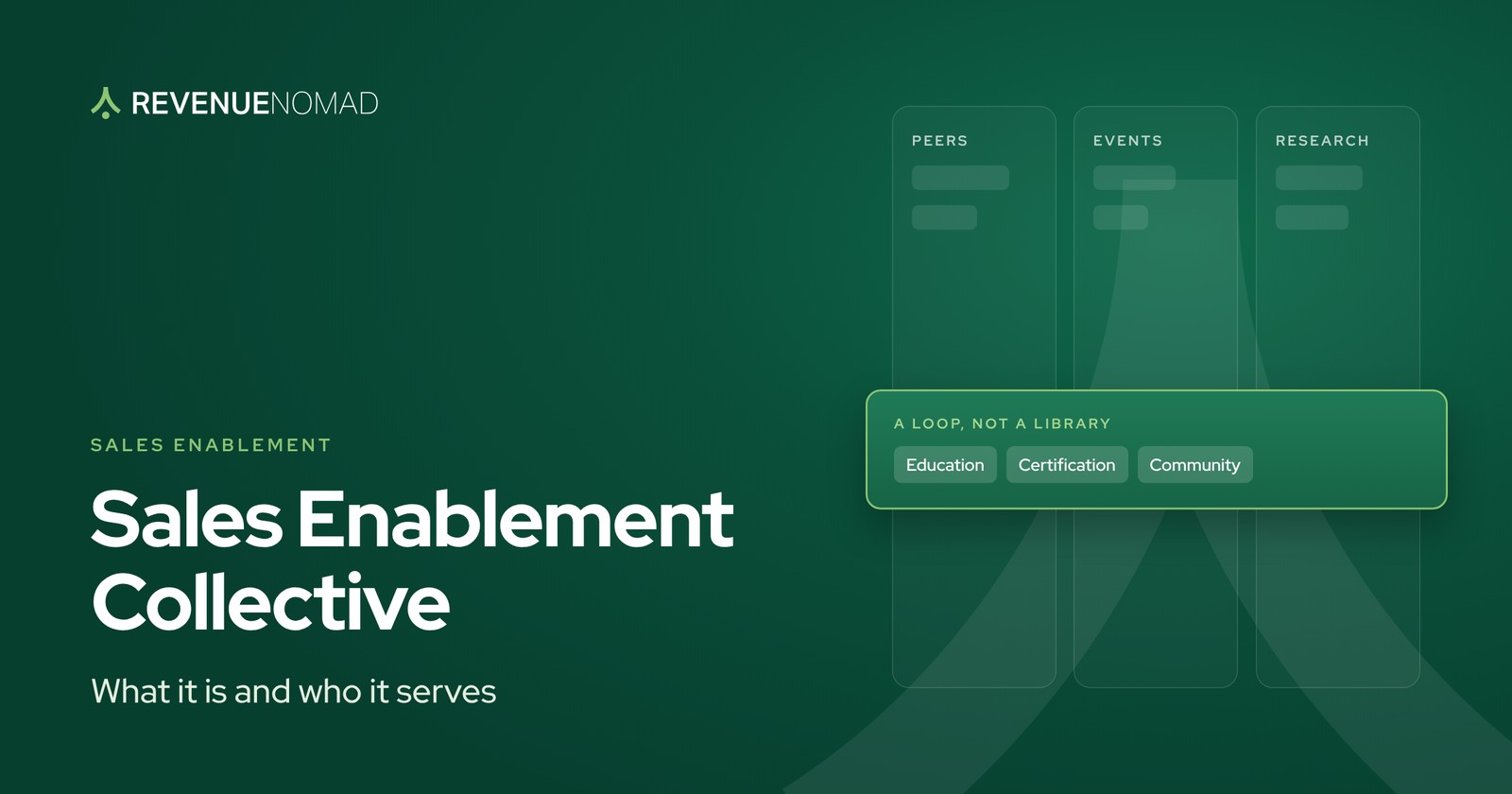
One point trips people up early: SEC runs as a loop, not a library. Research findings shape the education, that education comes alive at events, certifications check what practitioners carried back to their teams, and member questions feed into what gets studied next. The figures SEC publishes reflect that loop. Each one counts a different kind of engagement, so a membership total and an event count measure different things rather than stacking into a single audience size. Judge any single article, session, or course by where it sits in that cycle. Each piece makes more sense as part of the loop than as a standalone product.
Community Scale in Numbers
SEC publishes several figures, and they confuse people because they look like they should add up. They don't. Each number counts a different layer of engagement, so you need to read them one by one.
The Sales Enablement Collective about page reports more than 10,000 community members, more than 800 certification alumni, over 20,000 membership subscribers, and more than 2,000 event attendees. The same description separately refers to a global network of more than 30,000 enablement professionals. Those are organization-reported figures with different audience definitions, so they shouldn't be added together or treated as unique individuals.
| Engagement layer | Reported figure | What it signals |
|---|---|---|
| Community members | More than 10,000 | Base for peer exchange |
| Certification alumni | More than 800 | Formal skills pathway completed |
| Membership subscribers | More than 20,000 | Recurring use of structured resources |
| Event attendees | More than 2,000 | Demand for live, community-based learning |
| Global enablement professionals in network | More than 30,000 | Broader professional reach beyond members |
How to Read Each Layer
Start with community members. That figure tells you whether there's a sizable base for peer exchange, questions, and discussion. If a team lead wants to know whether SEC has enough active peers to learn from, this is the first number to check, not the broader network total.
Certification alumni signals something narrower and deeper. It shows people completed a formal skills pathway, which is different from reading articles or attending a session. Membership subscribers points to recurring use of structured resources, while event attendees shows demand for live, community-based learning where practitioners can question speakers and each other.
The more than 30,000 network figure describes broader professional reach. It may include people who follow SEC, consume research, or appear in its wider audience without being core community members. Using that number to estimate how many people will answer your post in a peer forum would mislead you.
Before you compare SEC with another community, ask what each organization counts as a member.
That single question prevents most bad comparisons. One group may count email subscribers, another may count paid members, and a third may count everyone who attended a free webinar. SEC is clearer than many because it separates the layers, but you still need to match the layer to your decision.
How the Collective Combines Five Formats
SEC's model combines peer networking, educational content, expert-led events, certifications, and research focused on sales enablement. Treat those five formats as a loop. Each one answers a different question, and each one makes the others more useful.
The diagram below maps the five formats around the Collective at the center.

What Each Format Does in Practice
- Peer networking answers who can I talk to. A first-time enablement manager asks peers how they built onboarding for account executives, what they cut, and what managers resisted.
- Educational content answers what should I learn. Articles and sessions on coaching, content governance, and onboarding design turn scattered problems into named skills you can study in order.
- Expert-led events answer what is changing. Practitioners present frameworks they've tested, and attendees can press them on context, team size, and failure points.
- Certifications answer how do I prove my skills. A structured path turns learning into a recognized credential, which helps when enablement still has to explain itself internally.
- Research answers what does good look like. Benchmarks show what mature teams measure and how they measure it, so you aren't judging your program by gut feel alone.
Notice how the loop turns. Research informs the education. Education gets tested when practitioners present at events and peers challenge the details. Peer discussion reveals where a framework breaks, and certification gives members a reason to keep returning and deepen the same skills.
The Collective works best as a loop, not a library.
The short video below is a useful companion if you want to hear the enablement role explained in spoken form before you explore further.
If your next question is who owns this work inside a company, the guide to sales enablement director duties, skills, and results connects the community's themes to a specific leadership role. Read it alongside SEC material and you'll start to see the difference between learning the discipline and staffing it.
Where the Collective Fits Beside Training and RevOps
The most common misconception is simple. People hear enablement and picture training sessions or a tidy content library. That narrow view causes real friction inside companies, because nobody agrees on what the enablement team owns.
The Sales Enablement Collective Sales Enablement Landscape Report 2024 found that in 2024, 39% of sales-enablement professionals identified a lack of formal internal alignment about what enablement is or does as one of their team's biggest challenges. SEC published that finding about its own field, which makes it a useful corrective. If your company can't define enablement, a community alone won't fix that.
Drawing the Boundaries Clearly
- Training builds skills at a point in time. A workshop can teach discovery questions, but it ends when the session ends.
- Content supplies assets. A battlecard, deck, or one-pager gives sellers material, but supply doesn't guarantee use.
- Enablement designs the system. It gets skills and assets used in live deals, reinforces them with managers, and measures whether seller behavior changed.
Say a company launches a product. Training is delivered on time and the slides are polished. Two weeks later, reps still pitch the old message because the new battlecard never reached the CRM, managers never practised the objection handling, and nobody checked call recordings. That's not mainly a training failure. That's an enablement failure, because the system around the training didn't carry the message into deals.
Enablement overlaps with revenue operations on data, process, and measurement. RevOps typically owns systems, definitions, and reporting integrity, while enablement owns adoption, coaching, and behavior change. Agree that split in writing, including who defines stage criteria and who inspects whether reps follow them. The breakdown of the revenue operations consultant role, work, and when to hire helps if you're deciding where that boundary sits in your team.
For the wider planning context that connects enablement to market execution, GTM planning and execution with H2 from H2 is worth reading before you assign owners. The limit is worth stating plainly. The Collective supports the discipline with peers and knowledge, but it doesn't run your program, coach your managers, or fix your CRM for you.
How to Get Value From the Collective
People waste a community membership by browsing. They read a little, save a lot, and change nothing in the next quarter. A tighter approach works better, because SEC has enough material to swallow your calendar if you let it.
The process graphic below highlights the first two moves, defining a question and reading the research before you act.

Six Steps That Keep You Focused
- Define one question before you join. Choose something concrete, such as ramping new reps faster or proving enablement's effect on win rate. Joining without a question leads to passive reading.
- Read the research and benchmarks first. Set realistic expectations for your team size and sales cycle before you copy a framework. Skipping this step makes mature-team practices look easier than they are.
- Join peer discussions that match your role. A first-time enablement lead and a manager of international teams need different advice. Generic threads give generic answers.
- Attend one expert-led event with a test in mind. Bring back a single framework to try next quarter. Attending everything dilutes follow-through and leaves you with notes instead of change.
- Decide whether certification fits your career path. Treat it as evidence of structured skills, not as a goal in itself. A credential won't compensate for a program nobody uses.
- Log what you tried and what moved. Record the intervention, the metric, the baseline, and the result so learning compounds across quarters.
Step six deserves extra care. The Sales Enablement Collective sales metrics guide reports that 61.2% of enablement professionals identify measuring impact and effectiveness as their biggest challenge. So agree the baseline before the experiment starts, and note that pricing, territory, and manager quality may also move the number.
For practical habits you can pair with SEC's material, Tutorial AI's sales enablement recommendations from Tutorial AI offers a useful checklist to compare against your own plan. If training quality is your chosen question, these high-impact sales training techniques give you concrete methods to test rather than another theory to admire.
End the first month with a 30-day check. You should be able to name one experiment, one metric, and one peer you spoke to. If you can't, you consumed content. You didn't yet use the Collective.
Decide Whether Joining the Collective Is Worth It
Joining suits some situations clearly. A first-time enablement manager who needs peers, structured onboarding ideas, and a credential will likely get value quickly. A leader running international teams who needs benchmarks and events also fits well, as does an operator who advises several companies and needs current practice across them.
It fits less well when a team has no enablement owner yet. In that case, a practical starting plan matters more than community access, because nobody has time to turn community insight into onboarding, playbooks, and manager coaching. Community knowledge only pays off when someone owns the follow-through.
Checks to Make Before You Pay
- Membership tier fit. Confirm which tier matches the resources you'll use.
- Certification fit. Check whether a certification matches your role and next career step.
- Event topic fit. Look at current topics and ask whether they address your named problem.
Pricing and tier details aren't covered here, so confirm them directly with SEC before you commit. Don't infer value from headline audience numbers. Match the format to your question, then decide.
When the gap is operational, such as no tested onboarding process, learning alone may move too slowly. A fractional enablement operator who builds onboarding and playbooks can create momentum while you learn. Revenue Nomad lists operators in categories including Sales Leadership, Marketing, Revenue Operations, Sales Enablement, Customer Success, Growth, AI GTM, Partnerships, and Sellers, which helps teams weigh that route against hiring or learning alone.
Make the decision small. Pick one question, choose one SEC resource that answers it this month, and measure the result in 30 days. If that loop produces a clearer baseline, a tested framework, or a useful peer relationship, joining has earned its place. If it produces only saved links, change your approach before you blame the community.
If your enablement gap needs hands-on help rather than more reading, Revenue Nomad connects companies with fractional sales, marketing, and revenue operations leaders matched to stage, industry, and revenue priorities. Browse vetted operator profiles, compare work history and reviews, and request an introduction when you're ready to turn a clear enablement question into a scoped engagement.